
In the high-stakes world of digital marketing, “scale” is the word on everyone’s lips. But how do you scale without losing your mind—or your rankings? If you’ve spent any time in the automation space, you’ve likely asked: What is a spintax generator?
At its core, a spintax generator is the engine that allows SEOs to create massive variety from a single source. In my experience, understanding this “spinning syntax” is the difference between a project that stagnates and one that dominates thousands of search queries simultaneously.
The Content Scaling Paradox
We all want more traffic, but more traffic requires more content. This creates a paradox: manual writing is too slow to cover every niche, but low-quality automation gets ignored by users and search engines alike.
Why manual variety is the bottleneck of your growth
From working with clients in the local SEO space, I’ve observed that the biggest hurdle is often the “city page” problem. Writing 500 unique descriptions for 500 different service areas by hand is commercially impossible. Manual variety kills your margins and slows your time-to-market.
Moving from “one-off” articles to dynamic content assets
The shift in 2026 is moving away from static posts toward dynamic assets. Instead of writing one article, you write one template that can blossom into hundreds of unique, high-quality iterations. This is where the power of spin syntax truly shines.
Understanding the Spintax Generator Mechanism
To use these tools effectively, you have to look under the hood. It isn’t magic; it is structured logic designed for content rotation.
Defining the architecture of automated variety
Think of spintax as a roadmap for a computer. It tells the software, “When you get to this point, you have three choices; pick one at random.”
The origins: From early black-hat scripts to modern programmatic tools
In the early days, spintax was a messy tool used for “link wheel” spam. Today, it has evolved into a sophisticated part of the programmatic SEO (pSEO) stack. We’ve moved from “black hat” tricks to “white hat” efficiency.
Visualizing the Logic: A breakdown of {curly brackets} and | pipes
If you look at raw spintax, it looks like code. Here is how it works:
- The Brackets
{ }: These wrap the options. - The Pipes
|: These separate the individual choices.
Example: We offer {fast|reliable|affordable} plumbing services.
The anatomy of a spin: How the selection engine picks your path
When you run this through a text spinner tool, the engine executes a random selection. One user sees “fast,” another sees “reliable.” The logic ensures that no two visitors (or search bots) see the exact same string of text consecutively.
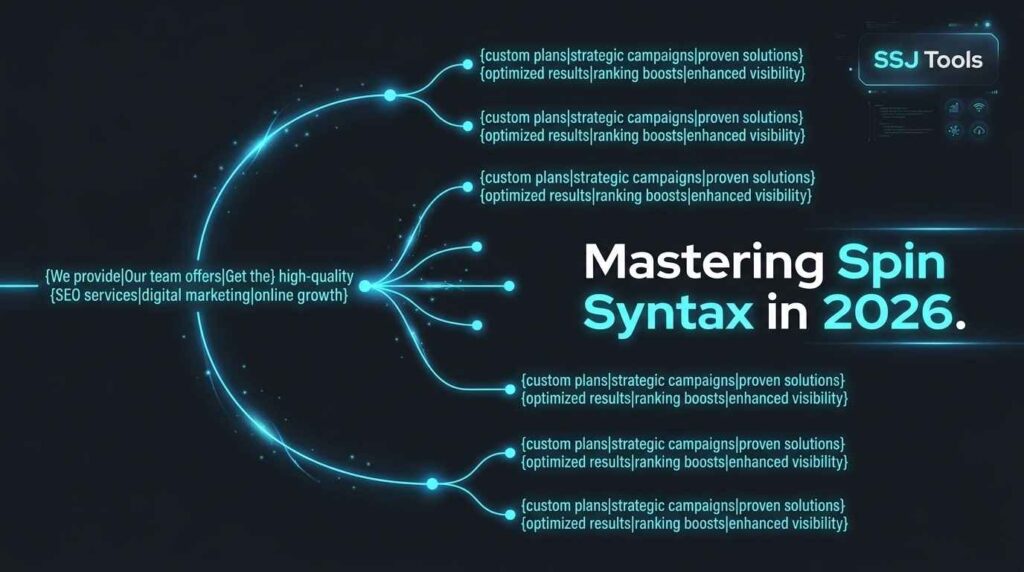
The Great Evolution: From Word Swapping to Contextual Logic
The technology has come a long way. Understanding these levels is key to maintaining quality.
Level 1: Simple synonym replacement (The “Old School” way)
This is the most basic form—swapping “happy” for “joyful.” It’s easy, but often results in clunky grammar.
Level 2: Sentence-level variance and flow
At this stage, you aren’t just swapping words; you are swapping entire sentence structures. This preserves the “voice” of the piece while drastically changing the underlying code.
Level 3: Advanced nested syntax for hyper-uniqueness
This is where the pros play. Nested spintax looks like this: {{Hello|Hi} there|Greetings}, {how are you|hope you're well}. This creates an exponential number of unique combinations, making it nearly impossible for content to feel repetitive.
Practical Realities vs. Common Myths
There is a lot of misinformation about how spin syntax affects SEO today. Let’s clear the air.
Myth: Search engines can easily detect all spintax
Many gurus claim Google “hates” spun content. In practice, search engines don’t hate the syntax; they hate low-value content. If the output is indistinguishable from human writing, it passes the test.
Reality: High-quality, manual-vetted syntax provides massive user value
When used for localized data (like weather reports or local business directories), spintax provides specific, helpful information to the user that would be too expensive to produce otherwise.
Common Mistakes: The “Set it and Forget it” trap
The biggest error I see is people generating 10,000 pages without checking the first ten. Always audit your output. If the logic is flawed, the error repeats 10,000 times.
My Expert Workflow: How I Integrate Spin Syntax into 2026 Strategies
I don’t use spintax for everything, but for specific tasks, it is unbeatable.
Using a text spinner tool for localized landing pages
For service businesses, I use a spintax generator to vary the “Why Choose Us” sections across different geographic pages. This ensures each page has a unique fingerprint.
Crafting varied meta descriptions at a 10,000-page scale
Meta descriptions don’t need to be Shakespeare; they need to be relevant. Spintax allows us to test which call-to-action (CTA) drives the highest click-through rate across an entire catalog.
Best Practices: The 70/30 rule for readability
My personal rule: keep 70% of your core message stable and spin 30%—specifically the adjectives, CTAs, and introductory phrases. This maintains the “truth” of the content while ensuring technical uniqueness.

Measuring the Results: Why the Format Matters
Why go through the trouble? Because the data supports it.
The benefits of reduced footprint in bulk outreach
If you send 5,000 emails with the same subject line, you get flagged. If you use spintax to rotate 20 different subject lines, your deliverability skyrockets.
Faster indexation through diversified header tags
Search engines prioritize unique headers. By spinning your H2s and H3s, you signal to bots that each page in your programmatic set is a distinct entity worth indexing.
Your Questions on Spin Syntax, Answered
Will using a spintax generator get my site penalized?
Not if the content is good. Penalties come from “thin content” or gibberish. If your spintax produces readable, helpful sentences, you are safe.
How do I ensure the final output actually makes sense?
Always use a tool with a “Preview” function. Read at least 5-10 random variations before you hit “publish” on a bulk project.
Is spintax still relevant now that we have LLMs like Gemini?
Absolutely. LLMs are great for generating the ideas, but spintax is better for controlling the structure at a massive, predictable scale.
Ready to build your first dynamic asset?
Efficiency is just a click away. [Try our Free Spintax Generator at SSJ Tools] and start scaling your content the smart way.