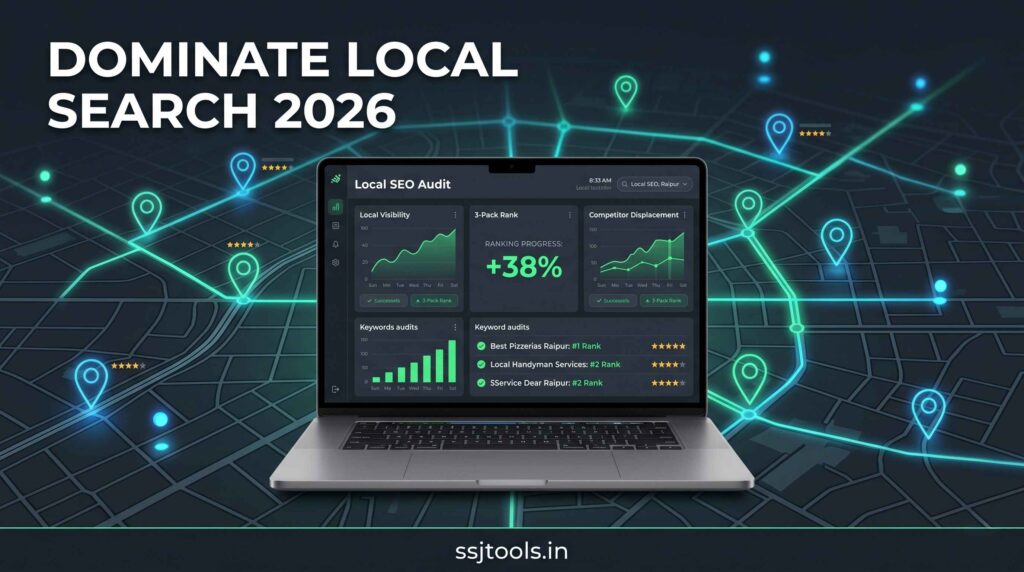
If you are a local business owner or a marketing freelancer, you already know that the “Local 3-Pack” is the holy grail of traffic. In my experience, ranking in the top three spots on Google Maps is worth more than a dozen standard organic listings. But as we move through 2026, the cost of professional tracking software has skyrocketed.
Fortunately, you don’t need a massive budget to win. You just need a smarter workflow. Finding the right free local seo tool can give you the same competitive edge as enterprise-level agencies. In this guide, I will share the exact toolkit I use to audit and rank local businesses without spending a dime on subscriptions.
The New Rules of Local Visibility: Why 2026 is Different
Beyond the Blue Links: The dominance of the Local Map Pack
In practice, mobile users rarely scroll past the map pins. Google has shifted its interface to prioritize immediate, location-based answers. If your business isn’t in that initial map view, you effectively don’t exist for 70% of local searchers.
Why “Free” doesn’t mean “Basic” in the modern SEO landscape
What I’ve observed over the last decade is that many high-end paid tools use the same publicly available data that free tools do. The difference is often just the “packaging.” By using the best local seo tools available for free, you can access raw, accurate data that is often more current than expensive, bloated platforms.
The 3-Step Audit Philosophy: Scan, Track, and Optimize
Every successful local campaign I’ve managed follows a simple rhythm:
- Scan your current presence to find errors.
- Track your positions across different neighborhoods.
- Optimize based on what the data tells you.
The “Anchor” Tool: Tracking Precision with Google Maps Rank Checker
Why this is my #1 free local seo tool recommendation
Before you change a single word on your website, you need to know where you stand. I always start with the Google Maps Rank Checker. It is the “anchor” of my workflow because it provides the most direct look at how Google perceives a business’s location relevance.
Real-time synchronization vs. stale cached data
Many paid trackers update once every 24 hours. However, local rankings can shift hourly. This google map ranking checker free synchronizes in real-time, giving you a “live” look at the SERPs (Search Engine Results Pages).
How to use the google map ranking checker free for batch location audits
Efficiency is key. Instead of checking one keyword at a time, I use this tool to input a batch of 10 keywords (like “Plumber New York,” “Leak Repair Brooklyn,” etc.). It opens multiple live views, allowing me to see the “Map Pack” density instantly.
Transitioning from data to strategy: What your “Map Rank” actually tells you
If you rank #1 at your office but #10 two miles away, you have a proximity and authority gap. The data from this checker tells you exactly where you need to build more local citations or gather more geo-tagged reviews.
Establishing the Foundation: The Best Local SEO Tools for Data Cleanup
Tool #2: Navigating the Citation Maze with a local listing checker
Google rewards consistency. From working with clients, I’ve found that the fastest way to drop in rankings is to have different phone numbers or addresses listed across the web. Using a local listing checker allows you to scan major directories to ensure your data is “clean.”
Identifying NAP (Name, Address, Phone) inconsistencies instantly
A single typo in your zip code on an old directory can confuse Google’s algorithm. These free checkers highlight exactly which sites need an update, saving you hours of manual searching.
Tool #3: The google local rank checker online for neighborhood-level insights
Local SEO is a game of inches. I use a google local rank checker online to simulate searches from specific zip codes. This helps me understand if a business is “local” to the entire city or just a small corner of it.
Tool #4: Business Profile Health Checkers (The GMB Essentials)
There are several free “Chrome Extensions” and web tools that audit your Google Business Profile (GBP). They check if you have enough photos, if your categories are correct, and if you are responding to reviews fast enough.
The Pro Workflow: How I Audit a Local Business in 15 Minutes
Phase 1: Running the baseline google local ranking check
I start by entering the business’s primary service and city into the rank checker. This gives me the “Current Reality.” If we aren’t in the top 3, we have work to do.
Phase 2: Detecting “Visibility Leaks” in your business description
I look at the results. Are competitors using keywords in their business names? Are they in a different primary category? I use these insights to tweak the client’s profile description and services list.
Phase 3: Benchmarking against the top 3 competitors in the Map Pack
I analyze the “winners.” If the top-ranking business has 50 reviews and my client has 5, the strategy is clear: we need a review generation campaign, not just keyword tweaks.
Common DIY Audit Pitfalls to Avoid
Relying on “incognito mode” (Why it’s lying to you about your rank)
Many people think “Incognito” gives a neutral result. It doesn’t. Google still uses your IP address to guess your location. To see the truth, always use a dedicated google local rank checker online.
Ignoring the proximity factor: The “Office Bias” in search results
You will always rank best when you are standing in your own shop. The real test is how you rank at the edge of town. Don’t let “Office Bias” make you think your SEO is perfect.
Overlooking mobile-first indexing in local search environments
In 2026, local search is mobile search. If your website takes more than 3 seconds to load on a 4G connection, Google will suppress your map ranking, regardless of how many reviews you have.
Future-Proofing Your Rankings: Best Practices for 2026
Prioritizing “High-Intent” localized keywords over broad terms
Don’t just chase “Plumber.” Chase “Emergency 24-hour plumber in [Neighborhood Name].” These high-intent terms are easier to rank for and convert much higher.
The role of user engagement signals in sustainable map rankings
Google is watching how people interact with your listing. Do they click “Call”? Do they ask for directions? Driving real engagement is now more important than just “keyword stuffing” your profile.
How consistent tracking leads to faster algorithm recovery
Google updates its local algorithm constantly. By using a google map ranking checker free weekly, you can spot a drop immediately and adjust your strategy before your lead flow dries up.

Take Control of Your Local Footprint Today
The map pack isn’t reserved for businesses with the biggest budgets; it’s reserved for those who are the most relevant. By using the Google Maps Rank Checker and following a disciplined audit workflow, you can outmaneuver much larger competitors.
Try the Google Maps Rank Checker for Free Now and start your journey to the top of the 3-pack.
Local SEO Expert: Frequently Asked Questions
Can I really rank on Google Maps without spending money on tools?
Absolutely. While paid tools offer automation, free local seo tool stacks like the one mentioned here provide the same core data needed to make winning optimizations.
How often should I use a google map ranking checker to see real progress?
I recommend a full audit once a week. Local SEO takes time to “settle,” so checking every hour will only frustrate you. Weekly checks reveal true trends.
Why do different free local seo tools show different ranking results?
Rankings change based on the virtual location of the tool’s server. This is why I prefer tools that synchronize directly with live Maps data for the most “human-like” result.
What is the most important factor for ranking in the Local 3-Pack this year?
Proximity remains #1, but “Review Velocity” (how many new reviews you get consistently) and “Category Relevance” are close seconds in 2026.
Is a local listing checker necessary if I only have one location?
Yes. Even one location can have dozens of incorrect “scraped” listings on the web that contradict your main profile.