
Have you ever wondered how does image SEO work when Google doesn’t actually have eyes? It’s a common misconception that Google’s sophisticated AI “looks” at your photography the way a human does. In reality, Google is a “blind” crawler that relies on a complex web of technical signals, text-based labels, and context to understand what is happening inside a frame.
If you want your visuals to appear in the coveted top rows of search results, you have to stop thinking about aesthetics and start thinking about data.
The Vision Gap: Why Google Doesn’t Actually “See” Your Photos
The Technical Translator: How algorithms convert pixels into semantic data. Google uses machine learning models to identify patterns, but it primarily functions as a translator. It takes pixel data and attempts to match it with “semantic” concepts. For example, it might identify a group of brown and green pixels as a “tree,” but it needs your help to know if it’s a “Northern Red Oak” or a “Handmade Artificial Bonsai.”
The “Blind” Crawler: Understanding why high-quality art fails without metadata. I have seen stunning, award-winning photography fail to rank for years simply because the creator left the technical side blank. Without text-based markers, a 4K masterpiece is nothing more than a heavy, unreadable file to an search engine.
Expert Insight: In my experience, even the most stunning photography remains invisible if the “digital label” is missing. You cannot rank what the crawler cannot identify.
Breaking Down the Pillars of Image Indexing
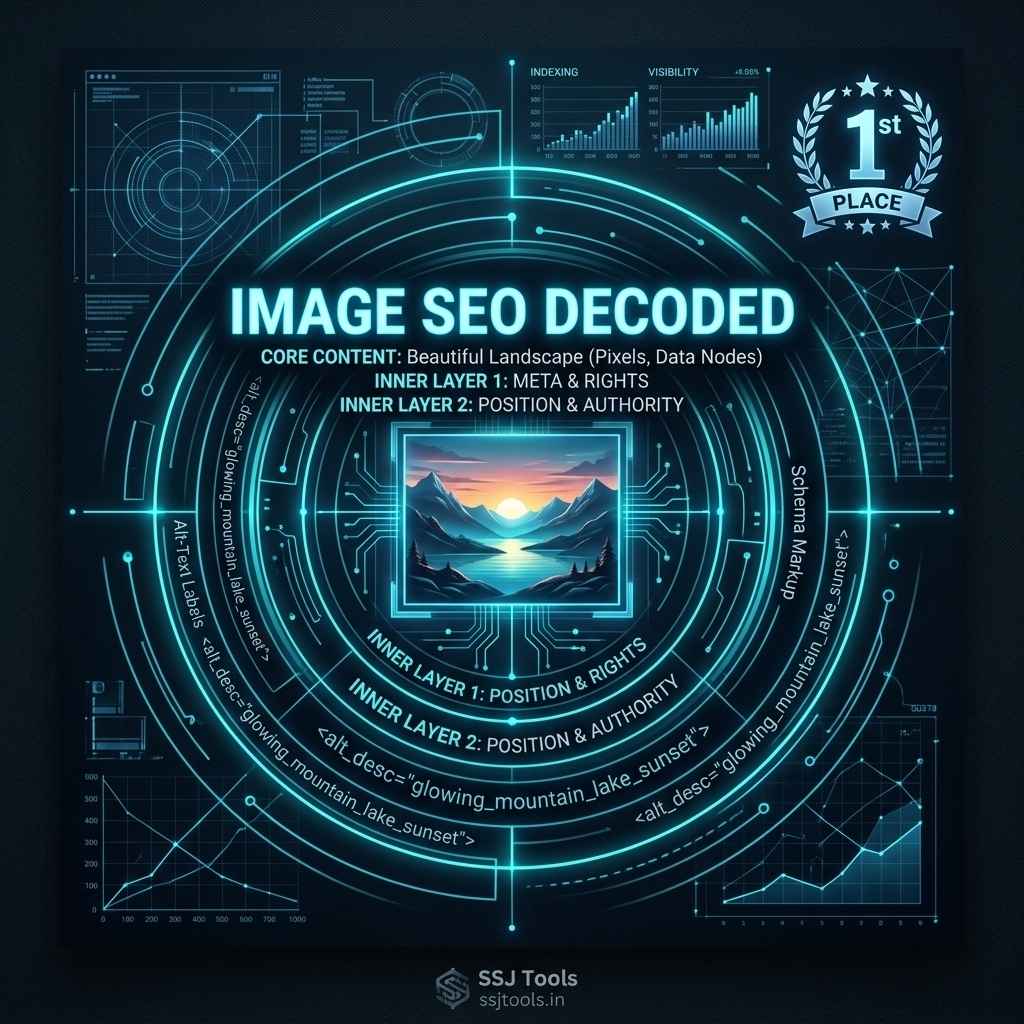
The Blueprint: Google Metadata SEO Image metadata SEO involves the hidden data embedded within your file. While Google doesn’t use every bit of EXIF data (like your camera’s shutter speed) for ranking, it does value IPTC metadata, which contains creator information and descriptions. Stripping all metadata to save file size is a mistake; keep the rights and description fields intact to build authority.
The role of page context: Why the text surrounding your image is a ranking signal. What I’ve observed in practice is that an image’s rank is heavily influenced by the copy it sits next to. If you have an image of a laptop surrounded by text about “baking recipes,” Google will be confused. Relevancy is determined by the proximity of keywords in headers and paragraphs near the file.
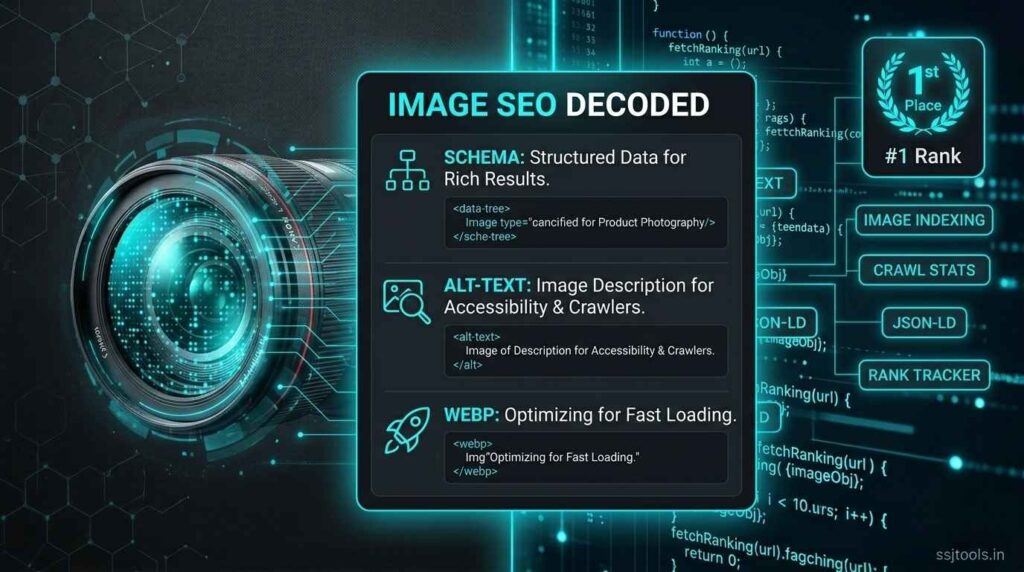
The ID Card: Actionable Alt-Text Best Practices Alt-text is the single most important factor in image indexing.
- Accessibility vs. Keyword Density: Write for the visually impaired first. If the image doesn’t load, the text should describe exactly what is missing.
- Why “Image of a blue car” is a wasted opportunity: Instead, use “Mid-size blue sedan parked in a modern driveway during sunset.” This provides specific descriptors that feed into visual search ranking.
Myth: “Google Can Read My Mind” vs. Reality: The Labeling System
The File Name Logic: Moving from DCIM_001.jpg to descriptive, hyphenated strings. From working with clients, I’ve noticed that file naming is the most ignored SEO win. Google looks at the filename as the first hint of content. Change final_version_02.png to industrial-grade-steel-wrench.png. It’s a permanent label that stays with the image wherever it is shared.
The Structured Data Edge: Implementing Image Schema to earn “Rich Result” badges. If you want that “Product” or “Recipe” badge in Google Images, you need Schema markup. This tells Google exactly what the image represents (a price, a rating, or an ingredient list), giving you a massive competitive advantage in visual search ranking.
Visual Search Ranking Factors: How user interaction signals relevance. Google tracks how users interact with your images. If users frequently click on your image and stay on your site (high dwell time) or zoom into the photo, Google views that image as a high-quality result for that specific query.
Performance vs. Aesthetics: The Technical Tug-of-War
Image Optimization Mastery: Balancing WebP compression with visual fidelity. Image optimization is about speed. In 2026, using JPEG for everything is outdated. WebP or AVIF formats provide superior compression without losing the “pop” of your visuals. A fast-loading image is much more likely to be indexed than a bloated 5MB file.
The Indexing Barrier: Common mistakes that prevent images from appearing. If your images aren’t showing up, check your robots.txt file. Many developers accidentally block the “Googlebot-Image” crawler. Another common mistake is using lazy-loading incorrectly, which can hide images from the crawler if not implemented with a “noscript” fallback.
Mobile-First Visuals: Why responsive image syntax is no longer optional. Most visual searches happen on mobile. Using srcset attributes tells Google you have different versions of an image for different screen sizes, ensuring a perfect user experience across all devices.
From Theory to Tracking: Measuring Your Image Authority
Why “Standard Search” rankings don’t tell the whole story. You might rank #1 for a text query but be nowhere to be found in the image grid. Visual search is a separate ecosystem with its own rules and its own traffic potential.
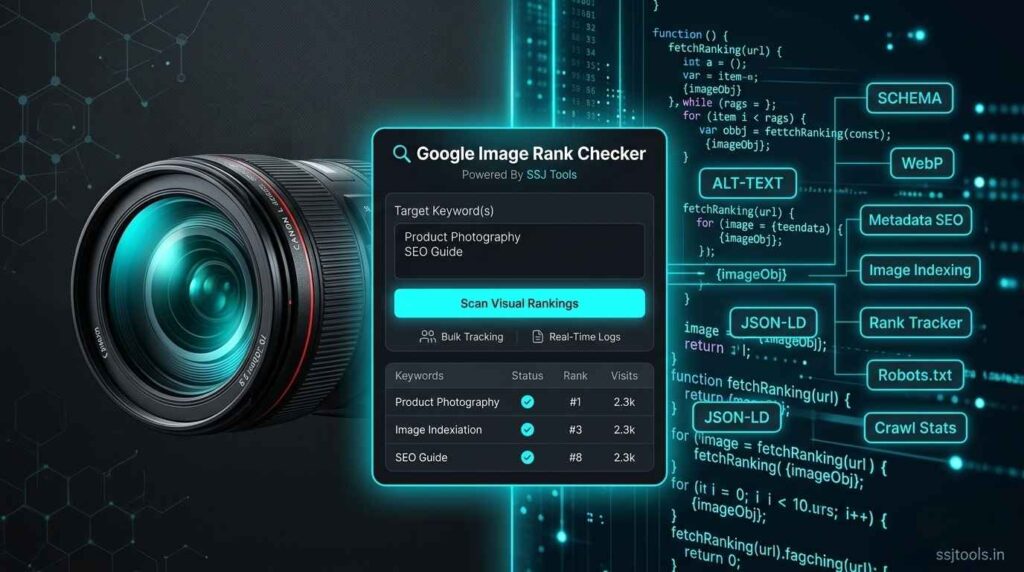
Practical Workflow: Using the Google Image Rank Checker. Once you’ve applied these technical signals, you need to verify the results. I recommend using the Google Image Rank Checker to perform a bulk audit of your target keywords. It’s the fastest way to see if your “technical labels” are actually moving you up the grid.
The “Top Row” Goal: Benchmarking your visual SERP real estate. Your ultimate goal is the first two rows. By tracking your progress, you can see which optimizations worked and which images need a metadata refresh.
Visual Search FAQs
Does Google use AI to “look” at my images now?
Yes, Google uses Vision AI to detect objects and text within images, but it still prioritizes your metadata (alt-text and filenames) to confirm its findings. Never rely on AI alone to do the labeling for you.
Is Alt-text still relevant in 2026?
Absolutely. Beyond SEO, it is the cornerstone of web accessibility. As semantic search grows, alt-text provides the “intent” that Google needs to match images with complex user queries.
Does the size of my image file affect its ranking?
Directly. File size affects PageSpeed, and PageSpeed is a confirmed ranking factor. A heavy image that slows down the user experience will be penalized in search rankings.
Can I rank for keywords that aren’t in my Alt-text?
Yes, if the surrounding page content is strong and the image is contextually relevant. However, including the keyword in the alt-text is the most reliable way to secure a spot.
How long does it take for a new image to appear in Google Images?
It can take anywhere from a few days to several weeks. Unlike text content, Google crawls images less frequently. Using an XML Image Sitemap can help speed up this process.