Many small business owners hit a plateau where their website exists, but the phone isn’t ringing. In my experience, the culprit is almost always a “broad term” strategy. If you are only targeting high-level terms, you are competing with global giants instead of reaching the neighbor who needs you right now. To win in 2026, you must learn how to find keyword variations that align with specific local intent.
The “Invisible Business” Syndrome: Why Broad Terms Are Killing Your ROI
The trap of high-volume, low-intent keywords
What I’ve observed over a decade in SEO is that beginners often chase the highest search volume. They want to rank for “Lawyer” or “Electrician.” While these terms look great on a report, they are often “low intent.” A person searching for “Electrician” might just be looking for a career path or a definition, not necessarily a service.
Why “Plumber” is a vanity metric but “Emergency Pipe Repair in [City]” is a paycheck
In practice, broad terms are vanity metrics. Ranking for “Plumber” globally is nearly impossible and mostly useless for a local shop. However, targeting “Emergency Pipe Repair in Chicago” connects you with someone standing in a flooded kitchen. That is a lead, not just a visitor.
In my experience: How 70% of local traffic is driven by specific intent
From working with clients, I’ve seen that the vast majority of converting local traffic comes from long-tail queries. These users aren’t browsing; they are solving a problem. If your content doesn’t reflect that specific intent, you remain invisible to your best potential customers.

Decoding the “Near Me” Algorithm
How search engines connect user proximity to your content
Google uses a mix of GPS data, IP addresses, and your website’s content to determine “relevance.” If your site explicitly mentions local landmarks, neighborhoods, and service variations, you provide the “proof” the algorithm needs to show your business to a nearby user.
The role of long-tail variations in triggering the Local Map Pack
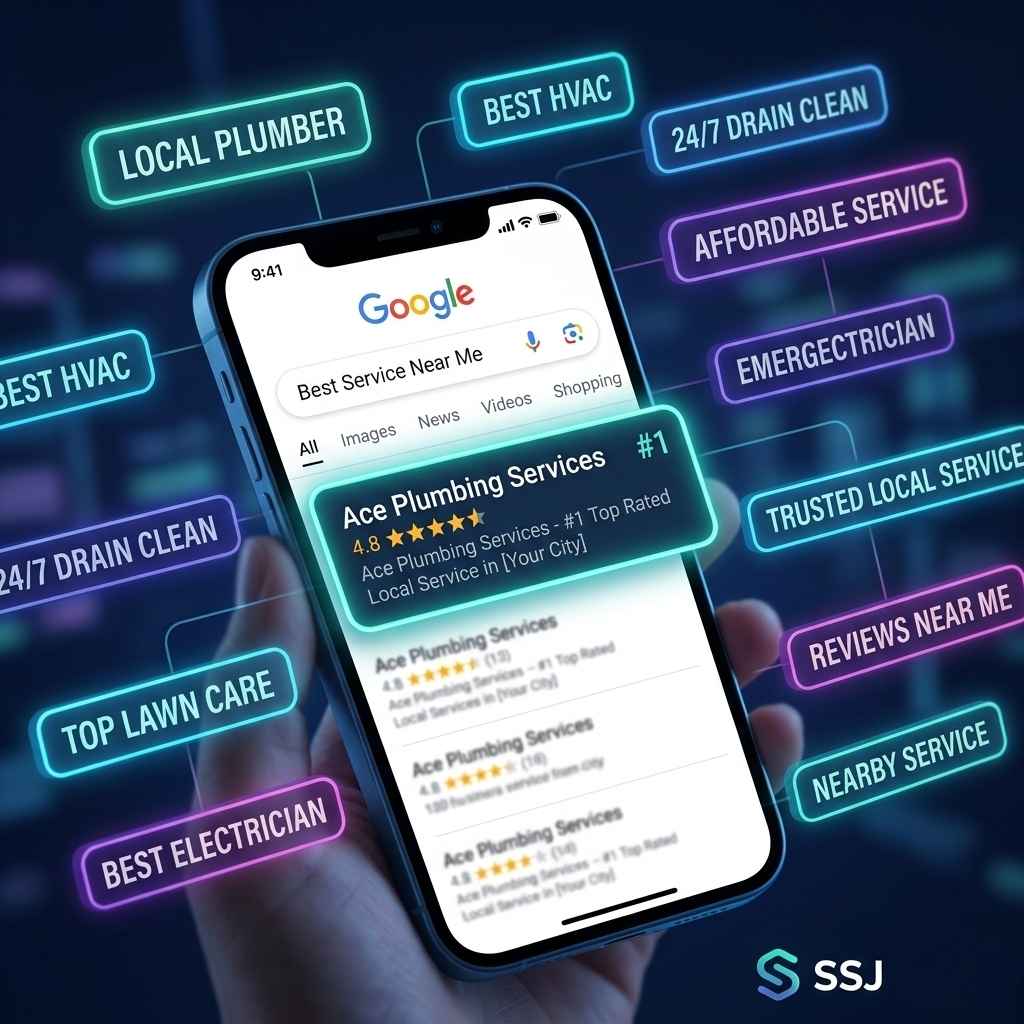
To show up in the coveted “Map Pack” (the top three local listings), your site needs to be contextually relevant. Using a local SEO tool to find variations like “best [service] near me” or “[service] open now in [neighborhood]” helps signal to search engines that you are the most convenient and relevant option.
Why “near me keywords” are the digital equivalent of a high-traffic storefront
In the physical world, location is everything. In the digital world, near me keywords are your location. If you don’t rank for these, it’s like having a store in a dark alleyway—no one knows you’re there, regardless of how good your service is.
The Solution: Implementing a Keyword Generator Tool for Hyper-Local Growth
Transitioning from manual guessing to data-driven expansion
Stop guessing what your customers type. Using a keyword generator tool allows you to move from “I think people search for this” to “I know people search for these 100 variations.”
How to find keyword variations that speak to local neighborhoods
Generic tools often miss the “micro-local” level. A specialized generator helps you find variations that include smaller suburbs, districts, or even local slang that a national tool might ignore.
The Keyword Variation Generator Workflow:
- Inputting your core service (The Seed): Start with your primary offer, like “Roof Repair.”
- Injecting city and “near me” modifiers: The tool automatically appends locations and intent-based words.
- Filtering for 2026 search trends and local slang: Get results that reflect how people actually talk and search today.
Actionable Roadmap: From Zero to 100 Local Rankings
- Identifying your service “Pillars”: List your top 3 services. Don’t try to rank for everything at once.
- Building your custom city and neighborhood list: Don’t just list the big city; list every suburb you are willing to drive to.
- Scaling variations to cover your entire service area: Use the Keyword Variation Generator to turn those 3 services and 10 suburbs into 30+ high-intent pages or sections.
- Distributing keywords: Place these variations naturally in your H2 tags, meta descriptions, and Google Business Profile updates.
Expert Best Practices & Avoiding The “Over-Optimization” Trap
Why keyword stuffing city names is a relic of the past
In the old days, you could just list 50 cities in your footer. Today, that gets you penalized. In my experience, each variation must feel like it belongs in a sentence.
Maintaining natural readability while targeting 100+ variations
Focus on the user first. Use the variations as “inspiration” for helpful content. If a keyword is “Affordable HVAC repair Brooklyn,” write a section titled: “Providing Affordable HVAC Repair for Brooklyn Homeowners.”
A common mistake: Forgetting to match website content with variations
Don’t generate keywords and then never use them. If you find a high-intent variation, make sure there is a paragraph on your site that actually answers that specific query.
Real-World Results: The 3x Conversion Lift
How localized intent lowers your bounce rate
When a user searches for something specific and finds exactly that on your page, they stay. This “perfect match” significantly lowers your bounce rate and tells Google your site is high quality.
The psychological impact of seeing one’s own city name
There is an immediate sense of trust when a customer sees their specific neighborhood mentioned. It signals that you are a “local expert,” which is often the deciding factor in who they choose to call.
Frequently Asked Questions
- Will a local SEO tool help if I don’t have a physical office?
- Yes. You can target “Service Areas” even without a storefront, which is vital for plumbers, cleaners, and mobile services.
- How often should I refresh my list of keyword variations?
- I recommend a refresh every six months to catch new local trends or changes in how people search.
- Is it better to target one big city or many small neighborhoods?
- Target both. The big city brings volume; the neighborhoods bring higher conversion rates.
- Do “near me” keywords work for service-based businesses?
- Absolutely. They are the primary driver of leads for HVAC, roofing, and emergency services.
- Can I use this keyword generator tool for Google Ads?
- Yes, it’s excellent for building “Exact Match” ad groups that lower your CPC and increase ad relevance.
Stop Guessing, Start Scaling: Generate Your Keywords Now
Don’t let your competitors own the “near me” space in your backyard. Use our Keyword Variation Generator to find the exact phrases your customers are using and start claiming your local search dominance today.