
When you sit down to sketch a website layout, you face an immediate hurdle: the copy is rarely ready. In my experience over the last decade scaling global web platforms, layout production completely stalls when teams wait for final editorial assets.
To bypass this bottleneck, professionals use a Lorem Text Generator to spin up temporary strings. But what exactly is this scrambled block of words, and what is lorem ipsum text doing on almost every design mockup on earth?
Understanding how to deploy this traditional dummy text correctly is crucial. It keeps your creative pipeline moving and ensures your technical typography stands up to real-world deployment pressures.
The Blind Spot in Modern Web Prototyping
The Natural Human Instinct to Read Over Reviewing Layouts
What I’ve observed during design sprints is a fascinating quirk of human psychology: people cannot resist reading recognizable words. If you fill a fresh mockup with temporary English sentences, your stakeholders will instinctively focus on the meaning of those sentences. Instead of critiquing your padding, column balance, or structural grid, they will comment on editorial phrasing.
How Readable English Accidentally Derails Visual Approvals
From working with clients, I know how easily readable draft content derails a high-value review meeting. A sentence like “Insert catchy promotional headline here” breaks the user immersion. The client starts brainstorming marketing copy in their head rather than assessing the structural integrity of your navigation layout or button placements.
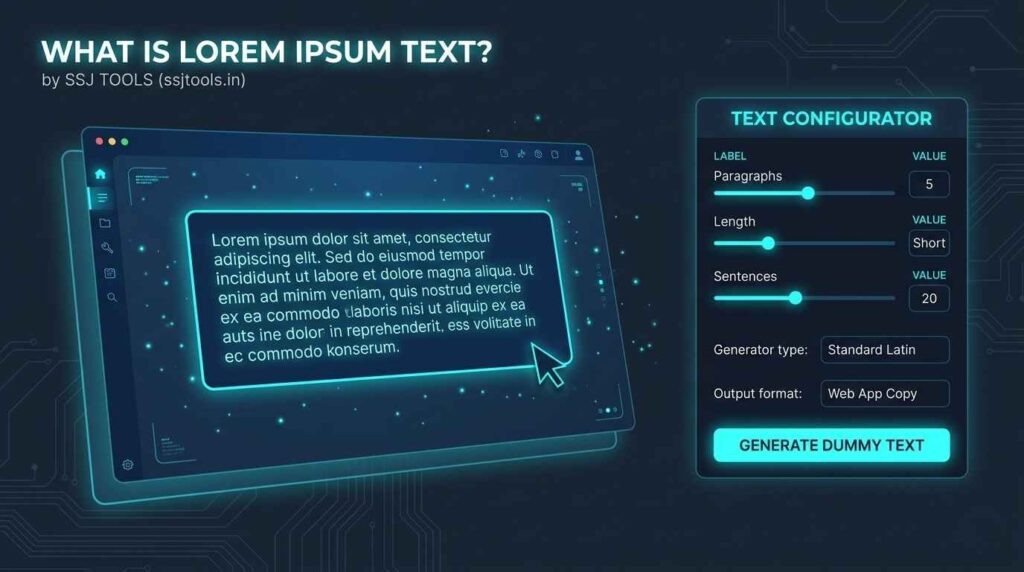
Decoding the Origin: What is Lorem Ipsum Text?
Stripping the Narrative: The Real Value of Scrambled Latin
To understand what is lorem ipsum text, you have to look at its core structural design. It is built out of classical Latin literature, specifically a treatise on ethics by Cicero. However, the modern adaptation scrambles the words, stripping away all literal narrative meaning. By removing the story, it functions as pure, objective visual weight.
Why This Specific Layout Balance Mirrors Real Editorial Distribution
Standard English contains predictable structural patterns, but simple geometric blocks or repeated strings of words do not mimic true human language. This latin placeholder text is universally adopted because it provides a highly realistic distribution of letters and words. The varying word lengths perfectly mirror the actual visual cadence of modern languages.
Myth vs. Reality: Debunking Common Filler Text Misconceptions
Myth 1: “Any Random Text Block Works for Typography Testing”
Many junior designers believe they can just copy-paste a single sentence twenty times to build out a block of text. This is a massive mistake that ruins accurate component evaluation.
The Chaos of Unbalanced Character Layouts
In practice, repeating identical phrases creates artificial, vertical patterns of white space known as “rivers.” Real editorial copy does not have uniform repeating sequences. Using structured lorem text avoids this visual defect, giving you an honest representation of paragraph density.
Myth 2: “Clients Prefer Seeing Real Content Drafts From Day One”
It sounds logical to use early content drafts right away, but it almost always backfires during early structural reviews.
Triggering Cognitive Bias with Incomplete Project Copy
If a client sees an incomplete or unpolished draft headline, their brain triggers an immediate negative reaction to the whole layout. Using neutral sample text keeps the meeting centered on architecture rather than unapproved messaging.
The Psychology of Filler Text in Visual Design
Keeping the Focus Strictly on Spacing, Grids, and Font Weights
By using an abstract placeholder text generator, you create a distinct separation between UI structure and messaging. This allows the engineering and design teams to critique spatial parameters accurately. You can tune your CSS column layouts, letter spacing, and line-height values without any distractions from the copy.
Managing Eyeball Tracking: Establishing a Clear Visual Hierarchy First
Good web design guides a user’s gaze smoothly down the page. Using uniform, scrambled strings allows an optimization team to map out a clear visual hierarchy. It makes it obvious whether your H2 headings stand out enough and whether your CTA anchors grab attention on their own merits.
Best Practices: Deploying Sample Content Without Breaking Your Workflow
Step 1: Set Up Your Container Bounds in Your Design Workspace
Before generating any filler blocks, draw out your structural columns and component boxes inside your design canvas to establish clear spatial limits.
Step 2: Generate Customized Paragraph Volumes with the Lorem Text Generator
Open up the online Lorem Text Generator. Rather than copying a generic, massive text block, customize your inputs to mirror real web components. Generate 1 to 2 short paragraphs for promotional cards, or output 4 to 5 denser blocks to test a blog column layout layout correctly.
Step 3: Audit Structural White Space Before Transitioning to Final Copy
Review your rendered text blocks globally across your grid system. Make sure your design layout looks clean, handles line breaks elegantly, and maintains proper structural margins before injecting final copy.
Critical Layout Mistakes Every Beginner Content Creator Makes
Mistake 1: Relying on Identical Replicated Sentences That Look Unnatural
Pasting the same short sentence repeatedly fails to test character variance. Ensure your generation engine builds naturally balanced word length strings to get an authentic typographic preview.
Mistake 2: Leaving Latin Placeholders Live in Production Indexing Staging Environments
Always run a final programmatic sweep before pushing your site to live servers. Leaving unfinished placeholder containers accessible to index spiders can accidentally lead to search systems archiving your internal test pages under nonsensical strings.
Elevating Your Wireframe Speed Today
Tap into the SSJ Tools Ecosystem for Rapid, Clean Prototype Deployment
Accelerate your visual building process by using the professional suite of formatting utilities available at SSJ Tools.
Transition Seamlessly from Structural Concept to Pixel-Perfect Reality
Get fast, reliable text layouts in seconds. Visit www.ssjtools.in to access our ultra-fast Lorem Text Generator alongside our full suite of free digital web tools designed to streamline your daily production cycles.
Frequently Answered Inquiries Regarding Placeholder Copy
Is Lorem Ipsum actual, grammatically correct Latin or just randomized words?
It is not grammatically correct Latin. While the words are rooted in a historical text by Cicero from 45 BC, the letters and syntax have been chopped, modified, and randomized over centuries to intentionally strip away meaning.
Can leaving dummy copy on a live page hurt search engine crawl metrics?
Yes. If search engines find large amounts of unoptimized placeholder strings on a public page, they may flag the URL as thin or low-quality content. Always remove test text before pushing your web code live.
Why does using actual localized languages too early destroy layout evaluation?
When stakeholders read a language they know, their analytical focus shifts away from the visual structure and centers entirely on the messaging. This hidden bias leads to overlooked flaws in padding, contrast, and alignment.
Is using AI-generated text or industry-specific text better than traditional Latin strings?
AI copy can work for late-stage prototypes. However, for early foundational wireframes, AI text still invites editorial critique. Scrambled Latin remains the fastest, most neutral way to evaluate raw visual space.
How do screen readers interact with standard scrambled placeholder text?
Screen readers will attempt to pronounce the scrambled Latin words phonetically, which can confuse accessibility testers. For comprehensive screen reader reviews, temporarily swap your placeholder blocks for accessible English dummy sentences.